Javier Carro Temboury
Erosure 4/7
EPUB, PDF
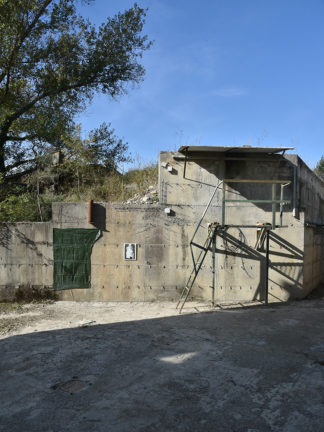
Entering La Centrale feels like the aftermath of a sandstorm. The erosion, caused by sand and air, has stripped away the outer layer of a group of second-hand objects.
The erosion has removed their visual identity, peeling the surface, to expose the core material they are fabricated in: the glaze goes away from ceramics, leaving naked clay; Wooden objets are stripped of their coating and mirrors don’t reflect anymore. Even the views are blurred as the earth blown onto the windows don’t let us see through.
The action of erosion is stopped by the definition of a border, a separation. As if a sandstorm just passed and everything under soil level or a “waterline” was preserved.
The original object is only recognizable in a small portion on the bottom of the objects.
The objects are the indicators to understand the work, that is in fact immaterial: it’s a set of instructions, the application of a drawing to a specific space.
The exhibition isn’t restricted to the main room. The horizontal axis situated at 4/7 takes into account the height of the building. It corresponds to four sevenths of the height of La Centrale, as if water level went a bit above the half of the building. As if the pillars weren’t enough to protect the construction from the rising water level of the nearby river Ardeche. The reference to wetness and it’s application into architecture gives a new reading to Temboury’s characteristic pattern drawing called “Continuous gesture for a constructive division.”
It reminds us of the greek ornament called “meanders.” A pattern of geometrical waves widely present in classical walls, friezes, pavements.
The project is echoed by a simultaneous exhibition “Erosure 2/4” in Nectar Projects in Vienna, Austria. The relation with architecture is a concern that is becoming more visible in Carro Temboury’s recent projects.